Insights
When OTAs Beat Your Hotel Website: Why AI-Powered Rate Matching Could Change Hotel Marketing in Indonesia
For years, Indonesian hoteliers have been fighting the same digital battle: “Why is my hotel cheaper on Booking.com than on my own website?” It sounds like a simple pricing problem. It isn't. It is a marketing problem, a distribution problem, a revenue problem—and increasingly, an AI problem. In 2026, the global hotel industry is beginning to respond with something more sophisticated than manually checking OTA prices every morning. Hotels are starting to use artificial intelligence to monitor...
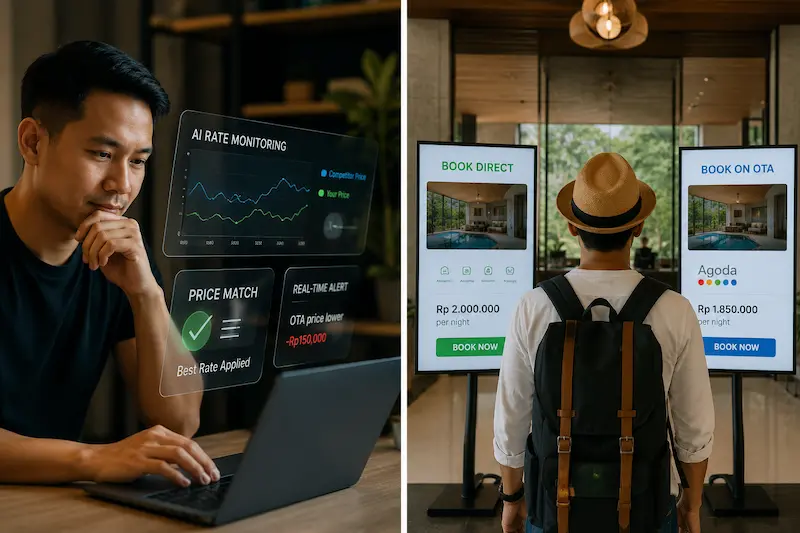
For years, Indonesian hoteliers have been fighting the same digital battle:
“Why is my hotel cheaper on Booking.com than on my own website?”
It sounds like a simple pricing problem.
It isn't.
It is a marketing problem, a distribution problem, a revenue problem—and increasingly, an AI problem.
In 2026, the global hotel industry is beginning to respond with something more sophisticated than manually checking OTA prices every morning.
Hotels are starting to use artificial intelligence to monitor rates across distribution channels and automatically protect the direct-booking channel. And for Indonesia's highly OTA-dependent hotel market, this could be a very important trend to watch.
The Hotel Website Has a Problem
Imagine this.
A traveler searches for a hotel in Bali. They find your property on Google and click through to your website.
Your official website shows: Deluxe Room — Rp 2,000,000/night
Then the traveler checks an OTA.
The same room appears for: Rp 1,850,000/night
What do you think happens next? Most guests don't call the hotel and ask why. They simply book the cheaper option.
The hotel has effectively paid to generate its own demand, only to lose the final transaction to a third-party channel.
And there is an additional cost. The hotel may now have to pay an OTA commission on a booking for a guest who could have booked directly.
This is why rate disparity is much more serious than simply having "different prices."
It can undermine the entire direct-booking strategy.
Indonesia Has an Especially Interesting Problem
Indonesia is one of the world's most digitally competitive tourism markets.
From Bali and Jakarta to Yogyakarta, Lombok, Bandung and Labuan Bajo, travelers have an enormous number of accommodation choices.
At the same time, Indonesian hotels operate across a complicated distribution ecosystem involving:
Agoda
Traveloka
Expedia
Traveloka
Google Hotels
Hotel websites
Social media
Metasearch
Wholesale distributors
Affiliate channels
Global and local travel agents
For many properties, OTAs remain an essential source of demand.
And that's not necessarily a bad thing.
The problem isn't using OTAs.
The problem is letting OTAs become the only place where guests feel confident booking.
The New Question: Can AI Protect the Direct Booking?
This is where things get interesting.
In July 2026, Radisson Hotel Group announced an AI-powered real-time price-matching system.
Instead of asking guests to find a cheaper OTA rate, take a screenshot, submit a claim and wait for approval, the system automatically detects eligible lower publicly available rates and matches them on Radisson's direct website.
This represents a fundamental change in how hotels can approach rate parity.
Traditionally:
Hotel → Monitor OTA → Find discrepancy → Investigate → Contact channel → Fix rate
The new model is closer to:
AI → Monitor distribution → Detect discrepancy → Verify → Match → Protect direct booking
That's a much more powerful proposition.
And it raises an important question for Indonesian hoteliers:
If AI can protect the direct booking channel in real time, should Indonesian hotels be doing the same?
Rate Parity Is No Longer Just a Revenue Management Issue
Traditionally, rate parity has been discussed mainly by revenue managers and e-commerce teams.
But the impact actually reaches almost every part of hotel marketing.
Think about a hotel investing in:
SEO
The hotel spends months trying to rank for:
"Best boutique hotel in Ubud"
Eventually, someone clicks the hotel's website.
But the OTA is cheaper.
The SEO investment helped generate the demand—but the OTA captures the booking.
Now consider:
Google Ads
The hotel pays for someone to click an advertisement.
The guest reaches the website.
They compare the price.
The OTA is cheaper.
Again, the hotel pays for the marketing while somebody else collects the booking commission.
The same problem can affect:
Facebook advertising
Instagram campaigns
influencer campaigns
email marketing
WhatsApp marketing
content marketing
Google Hotel Ads
retargeting
This is why rate parity should be considered part of marketing performance—not just revenue management.
The Indonesian OTA Challenge
For Indonesian hotels, this becomes even more complicated because travelers are extremely comfortable comparing multiple booking channels.
A guest might discover a hotel on Instagram.
Then check Google.
Then compare Agoda.
Then check Traveloka.
Then look at Booking.com.
Then send the hotel a WhatsApp message:
"Can you give me a better price if I book directly?"
The guest is effectively running their own mini revenue-management system.
And today's travelers can compare prices much faster than hotel teams can manually monitor them.
That's where automation becomes valuable.
Why Manual Rate Checking Doesn't Scale
Let's imagine a 100-room hotel selling across five major OTAs.
A revenue or e-commerce team may need to monitor:
Multiple room categories
Multiple dates
Different cancellation policies
Different occupancy levels
Promotions
Mobile rates
Member rates
Currency differences
Taxes
Packages
Flash sales
Closed-user rates
And the problem isn't necessarily finding one discrepancy.
The problem is finding every discrepancy, every day.
By the time someone discovers a rate problem manually, hundreds of potential customers may already have seen the cheaper OTA price.
This is where AI can change the economics.
AI doesn't need to sleep.
It doesn't need a spreadsheet.
It doesn't need someone to check 50 screenshots every morning.
It can continuously monitor thousands of pricing signals and identify anomalies much faster than a human team.
But Should Indonesian Hotels Simply Match Every OTA Price?
No.
This is where hotel strategy becomes important.
AI-powered rate matching shouldn't mean:
"If OTA is cheaper, automatically make our website cheaper."
That could create another problem.
Instead, hotels need to understand why the discrepancy exists.
For example:
Scenario 1: Genuine rate error
Hotel website:
Rp 1,500,000
OTA:
Rp 1,350,000
The OTA shouldn't be cheaper.
The hotel should investigate the distribution setup.
Scenario 2: OTA-funded promotion
OTA:
Rp 1,350,000
Hotel:
Rp 1,500,000
The OTA may be funding part of the discount.
In this case, blindly lowering the hotel's own rate could unnecessarily reduce revenue.
Scenario 3: Different booking conditions
OTA:
Rp 1,400,000 — non-refundable
Hotel:
Rp 1,500,000 — free cancellation
That's not necessarily a genuine rate disparity.
The guest is buying different conditions.
Scenario 4: Closed-user/member pricing
An OTA member might receive a special price that isn't publicly available.
Again, automatically matching that rate could be a mistake.
The Future Is Not "OTA vs Direct"
This is an important distinction.
We don't believe Indonesian hotels should try to eliminate OTAs.
For many properties, that would be unrealistic.
OTAs provide enormous benefits:
Demand generation.
International exposure.
Market reach.
Customer acquisition
Booking infrastructure
Consumer trust.
The smarter strategy is:
OTA for acquisition. Direct for relationship.
Use OTAs to introduce your property to new guests.
Then use your direct channel to build the relationship.
That means the objective isn't:
"Get rid of OTA."
It's:
"Don't let OTA own every guest relationship forever."
Direct Booking Needs More Than a Cheaper Price
There is another lesson here.
Hotels shouldn't compete with OTAs only by saying:
"Book direct and get 10% off."
That's often a race to the bottom.
Instead, direct booking can compete through value.
For example:
Book Direct Benefits
Free airport transfer
Complimentary breakfast
Room upgrade
Flexible check-in
Late check-out
Welcome drink
Spa credit
Dining credit
Free Wi-Fi upgrade
Exclusive experience
Loyalty benefits
Priority requests
The objective is to make the direct channel more valuable, not simply cheaper.
And this can be particularly powerful for Indonesian boutique hotels and resorts where the experience itself is a major part of the product.
Now Add AI Search to the Equation
Here's where the story becomes even more interesting.
AI is changing how travelers discover hotels.
Instead of searching:
"Hotels in Bali"
travelers increasingly ask AI systems questions like:
"Find me a quiet boutique hotel in Ubud for a romantic trip, preferably surrounded by nature and close to good restaurants."
The AI isn't simply returning ten blue links.
It is interpreting the request and recommending properties.
This means hotels now need to think about two different types of digital visibility:
Traditional SEO
Can Google find my hotel?
AI visibility
Can AI understand and recommend my hotel?
A recent 2026 study of AI recommendations in Canggu and Ubud is particularly interesting for Indonesia. Researchers examined thousands of AI-generated recommendations across multiple systems and found that many venues were never recommended at all. Their analysis associated recommendation visibility with signals such as review volume, having an owned website, published price information and third-party web mentions.
That suggests something important:
Being a good hotel isn't enough.
Your hotel needs to be digitally understandable.
AI Needs Consistent Hotel Data
Think about how an AI system might evaluate your hotel.
It may encounter:
Your website:
"Luxury jungle retreat with private pool villas."
"Deluxe Villa."
Agoda:
"Private Pool Villa."
Google:
"Resort hotel."
Tripadvisor:
"Boutique accommodation."
Instagram:
"Romantic Bali escape."
If the information is inconsistent, outdated or incomplete, the machine has to figure out what is correct.
The same issue applies to pricing.
If your website says:
Rp 2,000,000
but an OTA says:
Rp 1,750,000
AI sees two different signals.
This is why rate consistency is becoming more important in the age of AI.
As HSMAI Asia Pacific recently highlighted, AI doesn't understand the internal reasoning behind a hotel's commercial strategy. It interprets the signals that the hotel publishes across the digital ecosystem.
The New Hotel Marketing Stack
For Indonesian hotels, I believe the future hotel marketing stack will increasingly look like this:
1. Revenue Management
Determine the right price.
↓
2. Distribution Management
Make sure rates and inventory are correctly distributed.
↓
3. Rate Monitoring
Continuously check the market and OTAs.
↓
4. AI Automation
Detect anomalies and respond quickly.
↓
5. Direct Booking
Give guests a compelling reason to book directly.
↓
6. First-Party Data
Capture the guest relationship.
↓
7. CRM & Remarketing
Bring the guest back.
↓
8. AI Visibility
Make the property discoverable and recommendable by AI.
This is much more sophisticated than simply:
"Let's run some Facebook ads."
What Should Indonesian Hotels Do Now?
You don't need to build your own AI system tomorrow.
But you should start with the fundamentals.
Step 1: Audit Your Rates
Check your hotel against:
Agoda
Traveloka
Expedia
Google Hotels
Your own website
Don't check only the headline price.
Check:
Room + dates + occupancy + cancellation + taxes + inclusions.
Step 2: Identify Your Real Direct Booking Rate
Don't just ask:
"Is our website cheaper?"
Ask:
"What does the guest actually pay at checkout?"
That is the number that matters.
Step 3: Stop Thinking About Rate Parity as a Once-a-Day Task
If your market changes continuously, checking prices once every morning isn't necessarily enough.
Technology can increasingly help monitor the market continuously.
Step 4: Build a Better Direct-Booking Proposition
Don't rely exclusively on discounts.
Create benefits that OTAs cannot easily replicate.
Step 5: Fix Your Hotel's Digital Information
Make sure your:
Hotel name
Address
Room types
Amenities
Prices
Policies
Photos
Reviews
Experiences
Contact details
are accurate and consistent everywhere.
This isn't just good SEO.
It's increasingly important for AI visibility.
The Biggest Opportunity for Independent Hotels
Large hotel chains have the resources to invest in sophisticated revenue management, distribution technology and AI.
Independent hotels often don't.
But technology is becoming increasingly accessible.
And that could create an interesting competitive opportunity.
A 40-room boutique hotel in Ubud doesn't necessarily need to beat a global hotel chain at everything.
It needs to be:
More relevant
More consistent
More visible
More responsive
More personal.
And increasingly, it needs to make sure the digital ecosystem accurately communicates those advantages.
The Future Hotel Booking Battle May Happen Before the Guest Visits Your Website
This is perhaps the biggest lesson from the current trend.
The traditional hotel marketing funnel looked like this:
Google → Website → Booking Engine → Reservation
The new funnel could look more like:
AI / Google / OTA → Comparison → Recommendation → Price Verification → Direct Booking
And in that environment, price consistency becomes part of the hotel's marketing message.
If a traveler—or an AI assistant—finds your hotel but discovers a cheaper legitimate rate somewhere else, you've already lost an important part of the battle.
The hotel website doesn't get a second chance simply because the marketing department has beautiful photos.
Final Thoughts: Don't Fight the OTA—Fight the Leakage
The OTA isn't necessarily the enemy.
Revenue leakage is.
If an OTA brings you a guest who would never have discovered your hotel, the commission may be a worthwhile acquisition cost.
But if your own marketing brings the guest to your brand, and the guest then books through an OTA because the OTA is cheaper or easier, that's a different story.
That's where hotel marketers should focus.
And AI-powered rate monitoring and price matching could become one of the tools that helps close that gap.
For Indonesian hotels, the opportunity is particularly interesting because the market is highly competitive, highly digital and increasingly dependent on multiple distribution channels.
The question for hotel owners and GMs is therefore no longer:
"Should we use OTAs?"
The better question is:
"Are we using OTAs to acquire guests—or are we allowing them to take guests we could have converted directly?"
Because in the next generation of hotel marketing, the winning hotel may not be the one with the most channels.
It may be the one that manages those channels with the most intelligence.
Let’s build your next chapter
Ready to bring your A game?
Tell us about your property. Let’s explore what’s possible together.